Treasury Clearing's New Toolkit

How CCPs are reshaping margin andcollateral

What the CME–DTCC cross-marginingexpansion signals about the next phase of U.S. Treasury clearing
AT A GLANCE
From 30 April 2026, customer-level cross-margining between FICC-cleared U.S. Treasury positions and CME-cleared interest-rate futures is available for eligible accounts. The biggest beneficiary is the cash-futures basis trade. Customers running offsetting cash and futures legs no longer post margin twice; instead the two legs are margined as a single net portfolio.

▸  Marginsavings capped at 80%:
On positions allocated to the newcross-margin (XM) accounts.

▸  Eligibility is limited to specific FCMs:
Only dually-registered BD-FCMs that are common members of CME and FICC qualify. Positions held elsewhere remain margined separately at each CCP.

▸ Bank capital is the unfinished piece:
Until U.S. Basel III aligns with the CCP risk model, dealer balance sheets may not reflect the full netting benefit, capping how much efficiency reaches clients.

A market reaching for safety, without losing liquidity

Cross-margining between FICC-cleared Treasury positions and CME Treasury futures has become a critical tool for managing capital in the evolving U.S. Treasury market - a market whose fragility was made vivid in March 2020 when hedge funds unwinding the cash-futures basis trade overwhelmed dealer balance sheets.

The SEC's 2023 clearing mandate, which requires clearing of cash trades by 31 December 2026 and repo by 30 June 2027, introduces the potential for “double margining” - customers running offsetting positions could otherwise post collateral separately at FICCfor the cash and repo leg and at CME for the futures leg. This can significantly raise working capital requirements and constrain participation by leveraged market intermediaries, who play a central role in market liquidity. Cross-margining allows economically offsetting positions across cash, repo and futures to be recognised as a single risk portfolio for margin purposes, materially reducing total margin obligations. The program is designed to keep the intermediaries the market depends on active - preserving the leveraged liquidity provision on which the Treasury market relies.

How it works

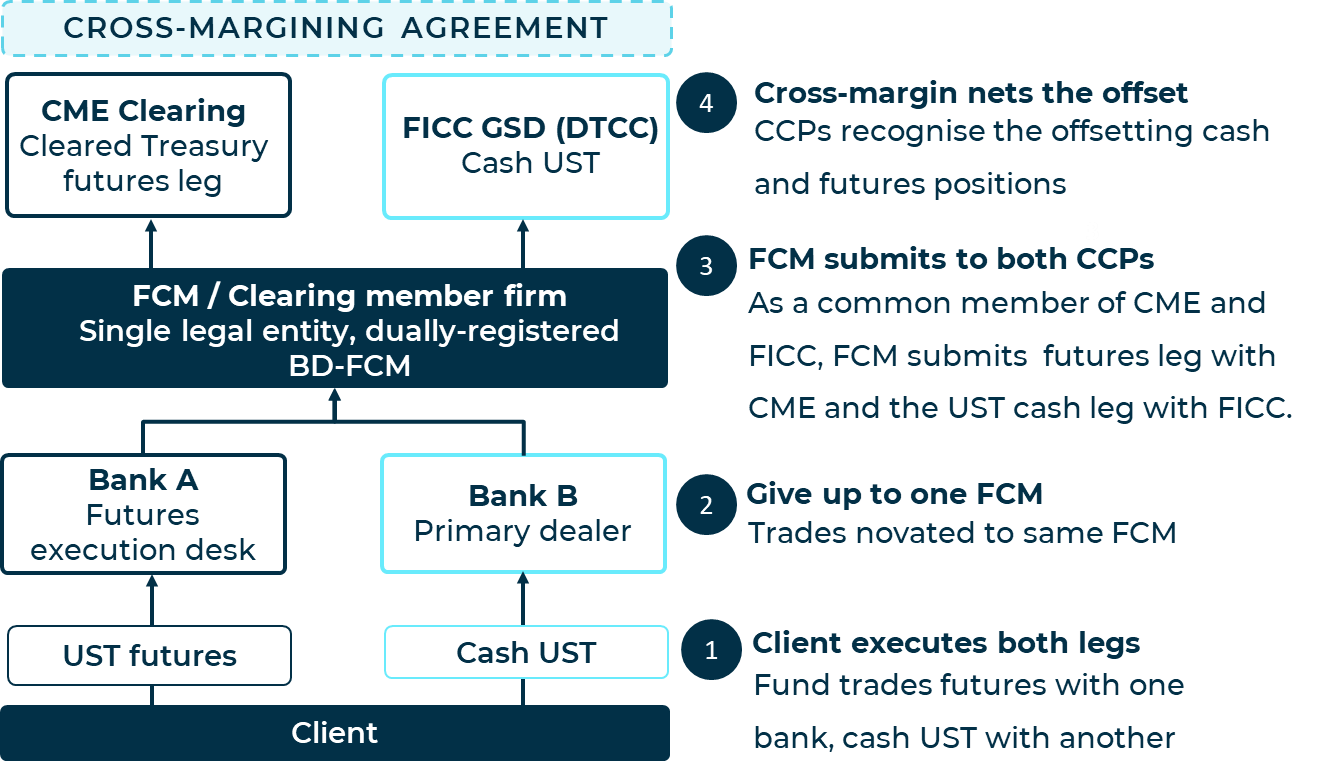
The program operates within a tightly defined perimeter. Eligible customers must qualify as Sponsored Members or Executing Firm Customers under FICC's rules; eligible products are U.S. Treasury cash and repo with more than one year to maturity. MBS, TIPS, and Treasuries within one year are excluded. Within that perimeter, the architecture is built around a single clearing path: a client's two trades originate at separate execution desks, flow via give-up to a single clearing FCM, and reach the two CCPs, where the Cross-Margining Agreement nets the offsetting risk into a singleinate at separate execution desks, flow via give-up to a single clearing FCM, and reach the two CCPs, where the Cross-Margining Agreement nets the offsetting risk into one margin call.  

Figure1.  How the program is structured
Cross-Margining Agreement
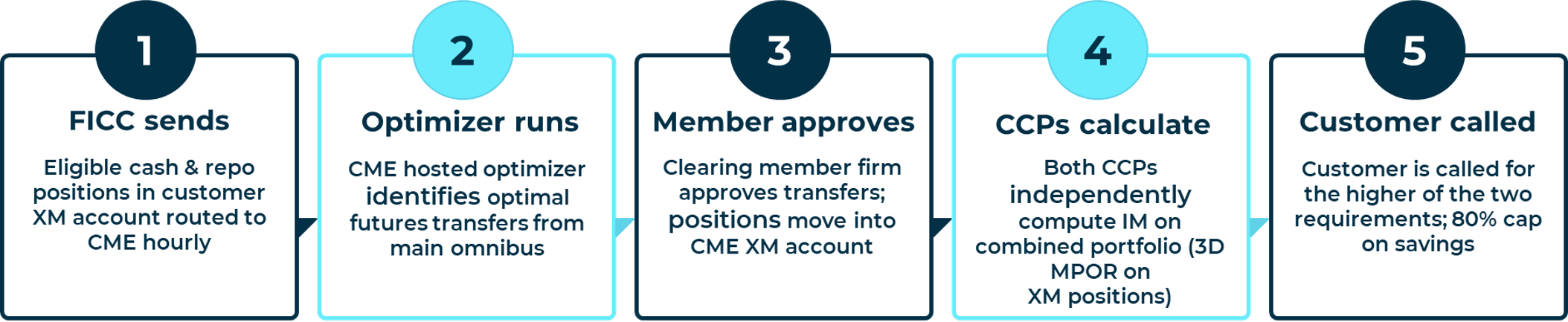
Within that structure, the program operates on a daily five-step cycle between FICC, CME's hosted optimiser, and the clearing member firm.
How the daily workflow runs

Figure2.  The five-step daily workflow
Five-step process between FICC, CME's hosted optimizer, and the clearing member firm
How Dailyflow runs
Source: CME Group, "CME-FICC Cross Margining for Customers" (April 2026), slides 6–8. Pre-trade margin testing is also available via the CME CORE API.

What changes for posted margin

A customer running both legs of a Treasury basis trade is margined twice for what is, economically, thesame risk: once at FICC for the cleared cash and repo, once at CME for the offsetting futures. Cross-margining solves that. CFTC data put leveraged-fund net short positions in Treasury futures at over $1 trillion notional in early 2025, almost all of it tied to the basis trade. Even modest margin savings on a book that size translate into meaningful working capital.

Margin posted twice vs. margin posted once

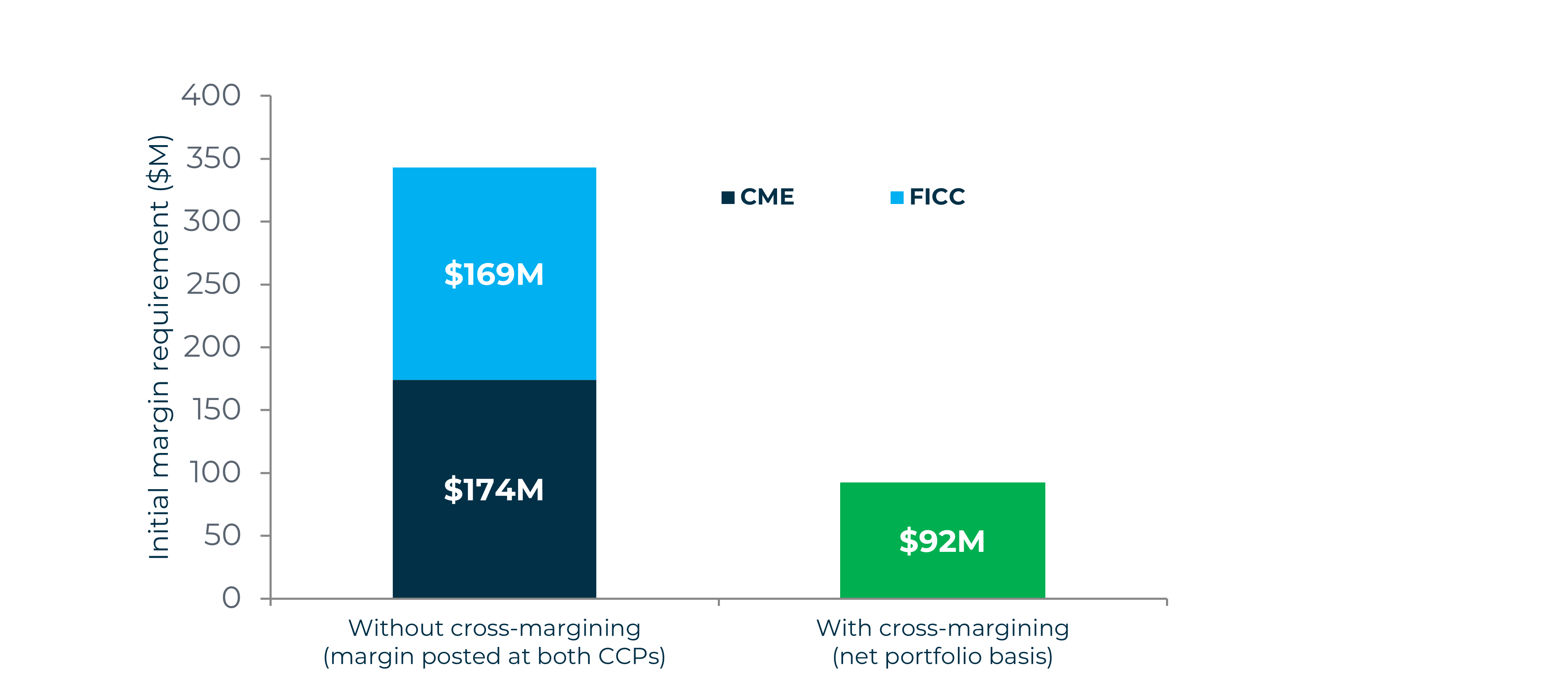
Figure3.  The shift in posted margin
What the same cash-futures basis book costs in initial margin, before and after cross-margining is applied
Source: CME Group, "CME-FICC Cross Margining for Customers" (April 2026), slides 6–8. Pre-trade margin testing is also available via the CME CORE API.
Without cross-margining, the basis trade is structurally overcollateralized at the clearinghouse: each CCP sees only its own leg and calls full initial and variation margin against it, with no visibility into the offsetting position sitting at the other venue. Cash and futures legs that economically hedge each other are margined as if they were standalone risks. With the program live, that double-posting collapses into a single net portfolio requirement, subject to a regulatory capof 80% on the savings applied to XM-account positions.

Who actually benefits

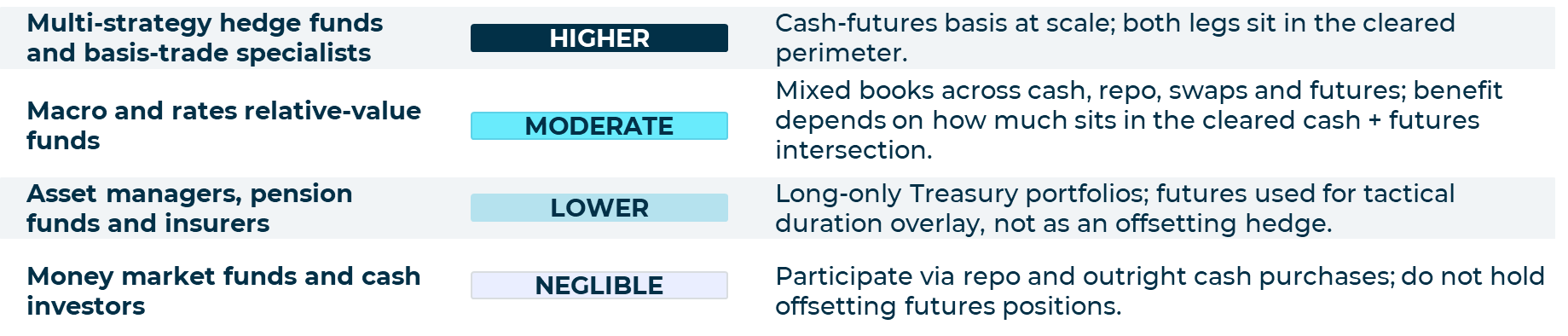
The benefit varies across the buy side. Some firms run cleared cash positions paired with offsetting futures; some hold only one of the two; some hold neither.

Not every Treasuryparticipant gains equally

Figure4.  Benefit by client type
Source: Author analysis. Ratingsreflect the typical structure of each client type's book; individual firms maydiffer.

How Tonic can help

Tonic helps clients navigate the complexities of U.S. Treasury clearing (USTC) by combining deep domain expertise with practical, execution-focused support. We work with dealer banks, hedge funds, asset managers, and infrastructure providers to move beyond compliance and optimize their clearing programs.

Specifically, we help firms:

Evaluate CCP clearing offerings and access models - We assess U.S. Treasury clearing options across FICC, CME, and ICE, including sponsored and agent clearing, collateral-in-lieu, and cross-margining opportunities to ensure clients maximize efficiency, flexibility, and operational effectiveness

Understand the capital implications of clearing - We analyse how different clearing strategies, account structures, and portfolio offsets impact dealer balance sheets, bank capital, and client margin outcomes, helping firms make informed decisions on efficiency and cost.

Design target operating models - From front-to-back workflows to operational connectivity, we create tailored operating models aligned with each firm’s systems, structure, and clearing strategy. This includes process mapping, role definition, and integration with clearing members and vendors.

By combining these capabilities with hands-on implementation support - including onboarding, documentation, and account connectivity. Tonic ensures clients can execute efficiently, optimize capital, and fully leverage the cleared UST market.

Contact Us

To discuss how thesedevelopments may impact your business, or to learn more about Tonic’s Treasuryclearing expertise, please get in touch.info@thetonicconsultancy.com

Find out how we can support your firm

Get in touch

Subscribe To Us

Gain exclusive access to Tonic updates, regular content, and our company newsletter 'Tonic Refreshment'

Thank you! Your submission has been received!
Oops! Something went wrong while submitting the form.